
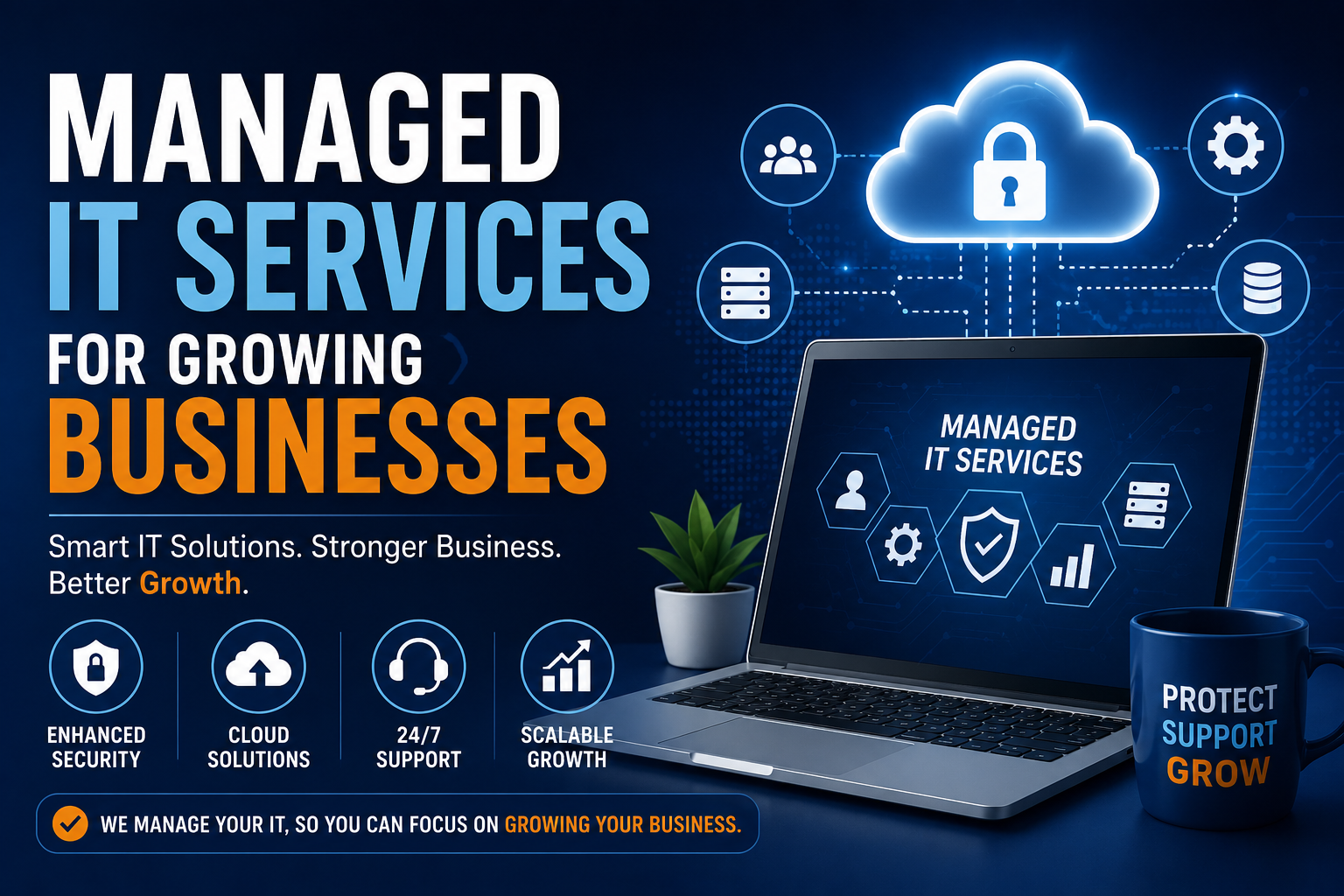
Managed IT Services for Growing Businesses
Introduction
Technology is now an essential part of almost every modern business. Companies rely on computers, cloud applications, networks, websites, business software, and digital communication to serve customers and manage daily operations. As a business grows, however, managing all these systems can become increasingly difficult. This is where managed IT services for growing businesses can provide valuable support.
Instead of handling every technology issue internally, businesses can work with an experienced IT service provider to monitor, maintain, secure, and manage their technology infrastructure. This approach can help organizations reduce technical problems, improve security, and allow employees to focus on their core responsibilities.
For small and growing companies, building a large in-house IT department may not always be practical. Outsourcing selected IT responsibilities can provide access to specialized expertise without requiring a full internal team. NIST notes that outsourcing cybersecurity needs to specialized third parties is a common option, particularly for smaller businesses with limited expertise, resources, or budget.
In this guide, we will explore what managed IT services are, their key benefits, common services, and how businesses can choose the right IT partner.
What Are Managed IT Services?
Managed IT services are technology services provided by an external IT company that helps businesses manage their technology systems on an ongoing basis.
Rather than waiting for something to break before responding, a managed service provider can take a proactive approach. Depending on the agreement, services may include network monitoring, technical support, cybersecurity, cloud management, backups, software management, and IT consulting.
The exact services depend on the business’s requirements and the provider’s service model.
How Managed IT Services Work
A managed IT provider typically begins by understanding the company’s existing technology environment. The provider can then identify potential problems, security risks, outdated systems, and areas where technology could be improved.
After that, the provider and business can establish a service agreement that defines responsibilities, support expectations, security requirements, and other important details.
NIST recommends that businesses clearly understand and document the service level, responsibilities, and expectations when working with an external cybersecurity provider.
Why Growing Businesses Need Reliable IT Support
Growth often brings new employees, additional devices, more software, larger amounts of data, and greater customer expectations.
A business that managed its technology easily with five employees may face very different challenges after expanding to twenty, fifty, or more employees.
Common challenges include:
- Increasing cybersecurity risks
- More devices and users to manage
- Software and system compatibility issues
- Data backup requirements
- Remote work support
- Cloud application management
- Network performance problems
- Limited internal IT expertise
- Unexpected technical downtime
Without proper IT management, these challenges can affect productivity and customer experience.
Key Managed IT Services for Businesses
A good IT provider can offer different services depending on the company’s size, industry, and technology requirements.
1. IT Help Desk and Technical Support
Employees may experience problems with computers, software, networks, email, printers, accounts, or other systems.
A professional IT support service gives employees a reliable place to report technical problems and receive assistance.
This can reduce the amount of time employees spend trying to solve technical issues themselves.
2. Network Monitoring and Management
A reliable network is essential for businesses that depend on internet-based applications and communication.
IT professionals can monitor network performance, identify potential problems, manage configurations, and help maintain reliable connectivity.
Regular monitoring can also help identify issues before they become major disruptions.
3. Cybersecurity Services
Cybersecurity is one of the most important areas of modern IT management.
Businesses need to protect systems, accounts, networks, and sensitive information from unauthorized access and other cyber threats.
NIST’s Cybersecurity Framework 2.0 provides businesses with a structured approach around six functions: Govern, Identify, Protect, Detect, Respond, and Recover.
Managed IT providers may support businesses with services such as:
- Security monitoring
- Endpoint protection
- Access management
- Security updates
- Threat detection
- Employee security awareness
- Backup and recovery planning
However, businesses should remember that outsourcing IT or cybersecurity does not remove their responsibility for protecting their systems and data.
4. Cloud IT Management
Cloud applications allow businesses to access software, files, and services through the internet.
As companies adopt more cloud platforms, managing accounts, permissions, configurations, security, and integrations can become challenging.
Managed IT providers can help businesses organize and maintain their cloud environments while ensuring employees have appropriate access to the tools they need.
5. Data Backup and Disaster Recovery
Data loss can create serious problems for a business.
Important information may include customer records, financial documents, project files, databases, website data, and internal documents.
A proper backup strategy helps businesses maintain copies of important information and prepare for unexpected events.
Disaster recovery planning should also consider how quickly critical systems need to be restored after an incident.
6. Software and Device Management
Businesses use many different applications and devices every day.
Managing updates, configurations, user accounts, licenses, and security settings manually can become difficult as the organization grows.
Managed IT services can help standardize these processes and keep technology environments easier to manage.
Benefits of Managed IT Services for Growing Businesses
1. Access to IT Expertise
A growing business may not have the budget to hire specialists for networking, cybersecurity, cloud systems, infrastructure, and technical support.
Managed IT services can give businesses access to professionals with different areas of technical expertise.
2. Better Cybersecurity
Security requires continuous attention because threats, software, and business environments change over time.
An IT provider can help businesses implement security practices and monitor systems consistently.
NIST emphasizes that cybersecurity requires ongoing attention and continuous improvement rather than a one-time solution.
3. Improved Employee Productivity
Technical problems can interrupt employee workflows.
When employees have access to responsive IT support, they can spend less time troubleshooting technology problems and more time completing their actual responsibilities.
4. More Predictable IT Costs
Unexpected technology problems can result in unplanned expenses.
A managed service agreement can provide businesses with a more structured way to budget for ongoing IT support, although pricing and included services vary by provider.
5. Easier Business Growth
Technology needs usually change as a company expands.
A managed IT provider can help businesses add users, devices, applications, and services as their requirements change.
This can make technology management more scalable.
6. Proactive Problem Management
Traditional IT support often focuses on fixing problems after they occur.
Managed IT services can take a more proactive approach by monitoring systems and identifying potential issues before they become serious.
This can help reduce avoidable disruptions.
Managed IT Services vs. In-House IT
Both approaches can work depending on the business.
An in-house IT team provides direct internal support and can develop detailed knowledge of the organization’s systems.
However, building a complete IT department can require significant investment in employees, training, tools, and infrastructure.
Managed IT services provide an alternative where an external provider handles some or many IT responsibilities.
For small businesses, outsourcing can be especially useful when specialized expertise is needed but maintaining a large internal IT team is not practical. NIST specifically identifies third-party support and managed service providers as options for businesses with limited cybersecurity resources.
Many growing companies can also use a hybrid approach, keeping some IT responsibilities internally while outsourcing specialized services.
How to Choose the Right IT Service Provider
Choosing an IT provider requires more than comparing prices.
Check Their Experience
Look for a provider that understands your industry, business size, technology environment, and specific requirements.
Review the Services
Make sure the provider clearly explains what is included in the service agreement.
Ask about:
- Technical support
- Monitoring
- Cybersecurity
- Backup
- Cloud management
- Response times
- Maintenance
- Reporting
Understand the Service Agreement
The agreement should clearly define responsibilities, support levels, response expectations, and important security requirements.
Consider Scalability
Your IT needs may change as your company grows. Choose a provider that can support additional employees, devices, locations, applications, and services when required.
Ask About Security
Cybersecurity should be an important part of your evaluation.
Ask how the provider handles access controls, monitoring, backups, incident response, and data protection.
NIST recommends that businesses establish clear cybersecurity outcomes and evaluate potential providers based on their ability to meet specific needs rather than focusing only on cost.
When Should a Business Consider Managed IT Services?
There is no single employee number that determines when a business should use managed IT services.
However, outsourcing IT support may become valuable when:
- Employees regularly experience technical problems.
- IT issues are taking management’s time.
- The business does not have dedicated IT staff.
- Cybersecurity requirements are becoming more complex.
- The company is moving to cloud-based systems.
- The business is hiring more employees.
- Data and applications are becoming harder to manage.
- Technology downtime is affecting customers or employees.
The important question is not simply how large the company is. It is whether the current IT setup can reliably support business operations and future growth.
Best Practices for Managing Business IT
Businesses can improve their IT environment by following a few basic principles.
Keep Systems Updated
Regular software and security updates help reduce vulnerabilities and keep systems functioning properly.
Use Strong Access Controls
Employees should only have access to the systems and information they need for their responsibilities.
Back Up Important Data
Businesses should maintain reliable backups and regularly review whether those backups can actually be restored.
Train Employees
Employees play an important role in cybersecurity. Basic awareness about phishing, suspicious links, passwords, and account security can reduce avoidable risks.
Review IT Regularly
Technology requirements change over time. Businesses should periodically review their systems, security practices, software, and support arrangements.
The NIST Cybersecurity Framework 2.0 is one useful resource for organizations looking to structure their cybersecurity risk-management approach.
The Future of IT Management for Businesses
Business technology is continuing to evolve through cloud computing, automation, artificial intelligence, remote work, and connected digital systems.
As technology becomes more important to daily operations, businesses need IT strategies that can adapt to change.
Managed IT services can provide ongoing technical expertise and support, allowing organizations to focus more attention on their customers, employees, products, and growth.
The most effective approach is not simply to outsource everything. Instead, businesses should identify their most important technology needs and build an IT strategy around security, reliability, scalability, and business objectives.
Frequently Asked Questions
What are managed IT services?
Managed IT services are ongoing technology services provided by an external IT company to help businesses manage systems, networks, devices, security, cloud platforms, and technical support.
Are managed IT services useful for small businesses?
Yes. Small businesses may benefit from outsourced IT support when they have limited internal expertise or resources. NIST identifies external providers and managed service providers as potential options for smaller organizations.
What is included in managed IT services?
Services vary by provider but may include help desk support, network monitoring, cybersecurity, cloud management, backups, device management, software maintenance, and IT consulting.
How do managed IT services improve cybersecurity?
They can support ongoing monitoring, security updates, access management, endpoint protection, backup strategies, and other security activities. However, businesses remain responsible for their overall data and security responsibilities.
How should I choose a managed IT provider?
Compare providers based on experience, services, security practices, response times, scalability, service agreements, and their ability to understand your specific business requirements.
Conclusion
Managed IT services for growing businesses can provide valuable technical support as organizations expand and their technology environments become more complex.
From cybersecurity and network management to cloud services, technical support, backups, and device management, a reliable IT partner can help businesses maintain a more organized and resilient technology environment.
The right approach starts with understanding your current IT challenges and identifying the services that can create the greatest business value. Instead of choosing a provider based only on price, evaluate expertise, security, service quality, scalability, and clearly defined responsibilities.
If your business is spending too much time dealing with technology problems or needs stronger IT support for its next stage of growth, now is a good time to evaluate your IT strategy and explore managed IT solutions.