

Look down while lying on your back. Do your lower ribs jut up like a small shelf? That is rib flare, also called flared ribs.
Here is the good news: the ribs are rarely the real problem. The pelvis, lower back, core and breathing pattern usually push them out. This guide shows you how to fix rib flare at home, step by step. It also covers when to see a doctor.
Table of Contents
What Causes Rib Flare (and Is It Just Being Skinny?)
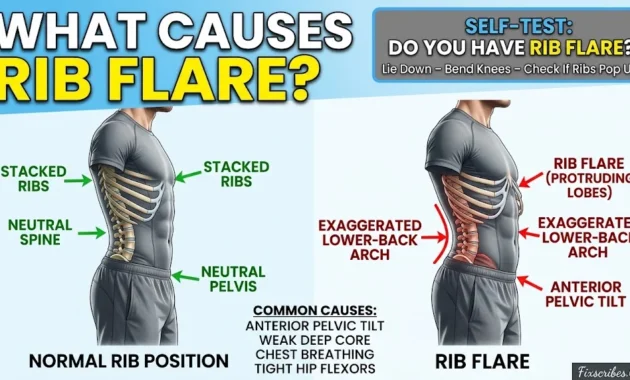
Rib flare happens when the lower rib cage tips up and out instead of sitting down and in. It is most visible lying flat or with your arms overhead.
While working on improving rib alignment, posture, and overall body mechanics, it’s also important to pay attention to other alignment issues that can affect everyday comfort and movement. If toe positioning is causing discomfort or making walking difficult, explore these practical non-surgical hammer toe relief techniques to improve foot comfort and mobility.
Most cases are postural. These are the usual drivers:
- Anterior pelvic tilt and hyperlordosis. An arched lower back tilts the rib cage back and lifts the front ribs.
- Weak deep core. The transversus abdominis helps hold the front ribs down. The upper part of this muscle attaches to the inner lower rib cage.
- Chest breathing. An elevated chest position can reduce contact between the diaphragm and the lower ribs.
- Tight muscles. Overactive lats, quadratus lumborum, spinal erectors and hip flexors keep pulling the cage out of line.
A smaller group has a structural cause, such as pectus carinatum (also called pigeon chest). It affects about 1 in 1,000 adolescents and is linked to overgrowth of the costal cartilage. Old rib fractures that healed out of line and scoliosis can also change rib shape.
Do I have rib flare or am I just skinny? Use this quick check:
- Lean: Ribs show, but they sit flat and look even on both sides.
- Rib flare: The lower edge tips up like a ridge, and your lower back arches off the floor.
- Self-test: Lie on your back with knees bent. If the lower ribs pop up as you breathe in, or your back arches, you likely have flare.
- Photo test: Take a side photo standing. Look for the ribs sitting ahead of the pelvis.
Rib flare shows up often in lifters, runners, dancers, gymnasts and new moms. These groups tend to arch the back or breathe high in the chest.
How to Fix Rib Flare: Step-by-Step Corrective Exercises
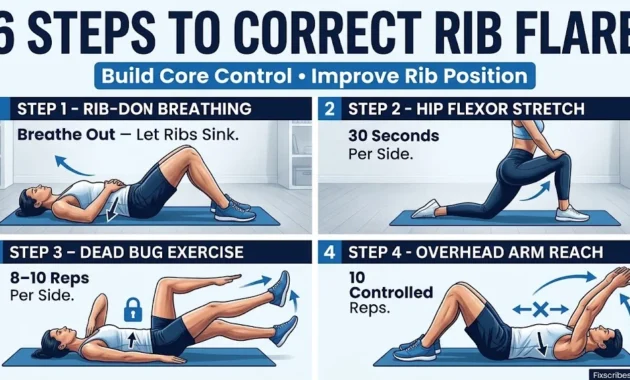
Can rib flare be corrected? Yes. Postural rib flare usually improves with steady retraining. The plan has three jobs: calm the arch, wake up the deep core and teach the ribs to sit down.
Do the steps in order. Go slowly.
Step 1: Find “ribs down” with your breath
Lie on your back with knees bent and feet flat. Place one hand on your lower ribs and one on your belly. Breathe in through your nose and feel the ribs widen to the sides. Then breathe out slowly and fully. Let the ribs sink toward the floor.
Step 2: Release the arch
Tight hip flexors keep pulling the pelvis forward. Do a half-kneeling hip flexor stretch for 30 seconds per side. Then practice a pelvic tuck. Tuck your tailbone under and flatten your lower back lightly. Do 10 reps lying down, then 10 standing.
Step 3: Wake up the deep core with a dead bug
Lie on your back. Lift your knees to 90 degrees over your hips. Reach your arms to the ceiling. Press your lower back gently into the floor. Breathe out and slowly lower your right arm and left leg. Keep the ribs down. Return and switch sides.
Do 8–10 reps per side, for 2–3 sets. If it feels too hard, tap just your heels to the floor. The diaphragm and transversus abdominis switch on before the limbs move, so this drill trains the right pattern.
Step 4: Reach overhead without flaring
Lie on your back with knees bent. Breathe in and reach both arms to the ceiling. Breathe out and lower them overhead. Stop when your ribs start to lift. That is your limit for today. Do 10 reps. Over time, your range will grow.
Step 5: Carry it into standing
Stand tall. Let the ribs settle over the pelvis. Do not puff the chest or suck in the belly. Think “ribs over hips.” Check yourself in a mirror from the side.
Step 6: Load the pattern
Rib control matters most under weight. Try these:
- Wall slides: Stand with your back to a wall and slide your arms up. Keep your ribs and lower back touching the wall.
- Front-rack holds: Hold a light dumbbell or kettlebell at your chest. Breathe out and keep the ribs stacked.
- Overhead press: Squeeze the glutes, breathe out and press without arching.
A simple weekly plan
- Daily: 2 minutes of rib-down breathing.
- 3 days a week: Hip flexor stretch, dead bugs, arm reaches.
- Every week: Take one side photo to track your progress.
Frequency beats long sessions. Short, steady practice teaches the new position.
Mistakes That Make Flared Ribs Worse

Some habits that look healthy actually deepen the flare. Here is what to stop doing.
- Puffing the chest to “stand tall.” It looks upright, but it lifts the ribs and arches the back.
- Sucking in your stomach. Gripping the abs hard blocks the diaphragm. Aim for a soft, breath-led brace.
- Doing endless back extensions. They can deepen the arch behind the flare.
- Holding your breath under load. Breathe out as you lift, and keep the ribs down.
- Lifting “chest up, back arched.” Aim for ribs over pelvis on every rep.
Daily habits matter too:
- Desk setup: Avoid sitting for hours in a slumped or arched position.
- Sleep: A big pillow under the upper back can exaggerate the arch. Try a small pillow under the knees instead.
- Clothing: Very tight waistbands can press on the lower ribs.
Do braces help?
Not for everyone. Braces are mainly used for pectus carinatum in growing teens with flexible chests. A 2024 review notes that bracing is the first-line choice for those cases. A rib belt or strap will not fix a postural flare in adults.
How Long Does It Take to Fix Rib Flare? When to See a Doctor
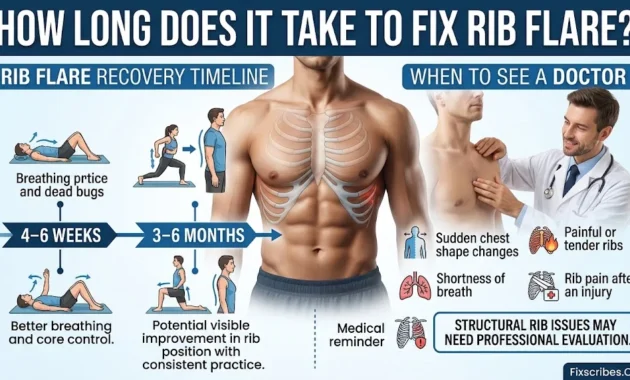
There is no set timeline, but most people follow a pattern. Better control of your breathing and core often appears in about 4–6 weeks. Visible change in rib position usually takes about 3–6 months of steady work.
These factors speed or slow progress:
- How long you have had the flare
- How tight your hips and lower back are
- How often you practice
- Whether the cause is postural or structural
See a doctor or physical therapist (DPT) if you notice:
- A sudden change in chest or rib shape
- A hard lump or a tender spot
- Pain with breathing, or shortness of breath
- Rib pain after a fall or impact
- A child with an uneven rib cage when bending forward
Start with your primary care doctor or a physical therapist. They can check posture, breathing and strength. If the flare looks fixed or structural, a thoracic or chest wall specialist may order a chest X-ray or CT scan. Diagnosis often starts with a simple visual exam, with imaging added when needed. Surgery is rare and only comes up after non-surgical care has been tried.
FAQs
Can rib flare be corrected?
Yes, in most postural cases. Retraining your breathing, core and pelvis position lets the ribs settle back down. Structural causes, like pectus carinatum, may need a specialist and sometimes bracing.
How do you reverse rib flare?
Use three steps. First, breathe out fully to bring the ribs down. Second, release tight hip flexors and reduce the lower-back arch. Third, train the deep core with moves like the dead bug. Repeat often, then carry the position into standing and lifting.
How long does it take for rib flares to go away?
Most people notice better control in about 4–6 weeks. Visible change often takes 3–6 months. Results depend on cause, severity and how steady your practice is.
Do I have rib flare or am I just skinny?
Thin people show ribs that look flat and even. Rib flare shows a raised lower edge and an arched lower back. Lie on your back with knees bent. If your ribs pop up or your back arches, you likely have flare.
Conclusion
Rib flare looks stubborn, but it responds well to a clear plan. Breathe the ribs down, calm the arch and train the deep core. Stay consistent for a few months and check your progress with a weekly photo. If anything feels off, see a physical therapist or doctor.